


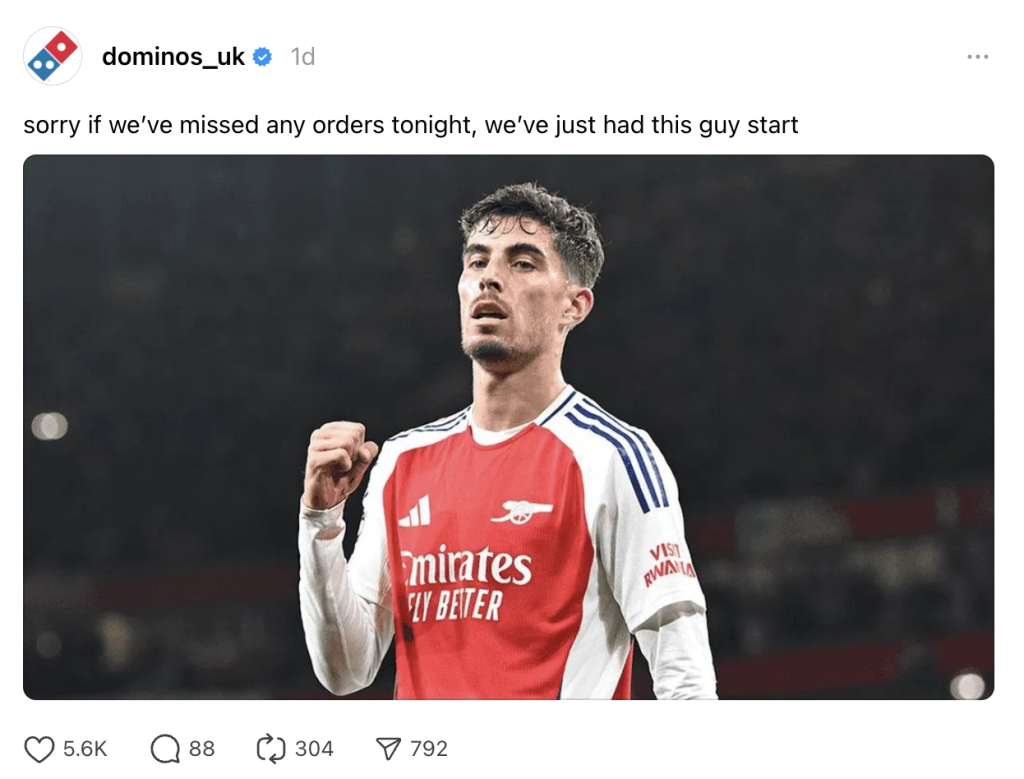
After Arsenal’s recent match against Manchester United, midfielder Kai Havertz received a barrage of online criticism for his performance. Domino’s Pizza UK joined the fray with a social media post stating, “Sorry if we missed any orders tonight. We’ve just had this guy start,” accompanied by an image implying Havertz’s involvement.
This incident highlights a troubling trend in which brands, pursuing engagement and visibility, publicly mock individuals, including elite athletes. While such posts may generate significant impressions and interactions, they raise serious ethical concerns about the human impact of these actions.
My new role as the ethical agent is to promote ethics in sports by aligning conscious brands and clients with athletes who care for people and the planet. It’s a moral standpoint to do the right thing. I have been guilty of playing on the form or physical appearance of athletes in the past to chase engagement, so former colleagues can undoubtedly throw the hypocrite card at me.
Athletes like Kai Havertz are not immune to the psychological effects of public ridicule. Enduring negative commentary can lead to stress, anxiety, and a decline in mental health. The ripple effect extends beyond the individual to their families, who bear the emotional burden of widespread public criticism. The issue of online abuse targeting athletes is widespread. Angry gamblers were responsible for nearly half of the 12,000 abusive social-media posts aimed at tennis players this year, according to a report published by Reuters.
The irony is brands understand the importance of an athlete’s engaged social channels, so why further fan the flames of toxicity when, at some point in the future, a brand will expect an athlete to promote their product or service on such channels? James Kirkham posted online this week highlighting “the huge numbers of players slowly switching off and rejecting agents offers to be a part of commercial deals because there just is not the need for them to put themselves in such a firing line”.
A study by Loughborough University found that up to one-third of social media posts directed at athletes contain negative content, including hateful and racial discriminatory remarks. Such pervasive negativity can have profound effects on athletes’ well-being and performance.
The amplification of such negative content is facilitated by social media platforms. Recent policy changes, such as Mark Zuckerberg’s decision to reduce content moderation on Facebook and Instagram, ostensibly to align with political shifts, exacerbate the issue. This reduction in oversight can create an environment where harmful content proliferates unchecked, further endangering individuals targeted by online abuse.
The question arises whether brands engaging in such behaviour should face the consequences. Regulatory bodies like Ofcom, responsible for overseeing communications in the UK, could consider implementing guidelines that hold brands accountable for online conduct that constitutes harassment or bullying. Additionally, legal frameworks could be explored to address cases where online mockery crosses into defamation or hate speech.
While the digital age offers brands innovative avenues for engagement, it also demands a heightened sense of responsibility. The pursuit of virality should not come at the expense of individual well-being. Brands must weigh the human impact of their content and consider the ethical implications of their online behaviour. Simultaneously, social media platforms and regulatory bodies have a role in ensuring that the digital space remains respectful and free from harassment.
I’m interested to see what impact platforms like Cleats Clubs provide athletes with integrity in terms of algorithmic control in an environment free of trolling. If athletes switch away from meta, x and TikTok to platforms where players can talk freely, brands and fans will ultimately win in the long run.